Table of Contents
- Why Commercial Electrical Maintenance Matters for Your Business
- Commercial Electrical Maintenance Checklist: Key Items to Inspect
- Building a Preventive Electrical Maintenance Plan
- Electrical Maintenance Schedule for Commercial Buildings
- Electrical Maintenance Log Template: What to Record
- Choosing a Qualified Electrical Contractor
- Conclusion
- Frequently Asked Questions
Last Updated: October 16, 2026
Why Commercial Electrical Maintenance Matters for Your Business
A commercial electrical system maintenance guide is only useful if it prevents the failures that cost you money, and that is exactly what a written maintenance program does: it catches worn breakers, loose terminations, and overloaded circuits before they shut down your operation. At All 4 You Electrical, we have handled commercial service calls across the Boise and Meridian area for over a decade, and the pattern is always the same. Systems that get inspected on a schedule fail less often, and when they do fail, the repair is smaller.
The stakes go beyond a tripped breaker. Electrical distribution equipment ages quietly. A panel that ran cool at 60 percent capacity for a decade can start overheating the year you add a second walk-in cooler or a bank of EV chargers. The Occupational Safety and Health Administration electrical safety guidance treats energized equipment and arc flash as recognized workplace hazards, which is why documentation of your maintenance activity matters as much as the work itself. Insurance carriers and inspectors ask for it.
Below, we break down what to inspect, how to build a preventive plan, how to schedule it, what to log, and how to hire someone qualified to do the work.
Commercial Electrical Maintenance Checklist: Key Items to Inspect
A commercial electrical maintenance checklist should cover the service entrance, distribution panels, branch circuits, grounding, and life-safety systems, in that order. Work from the source outward so you find upstream problems before they damage downstream equipment.
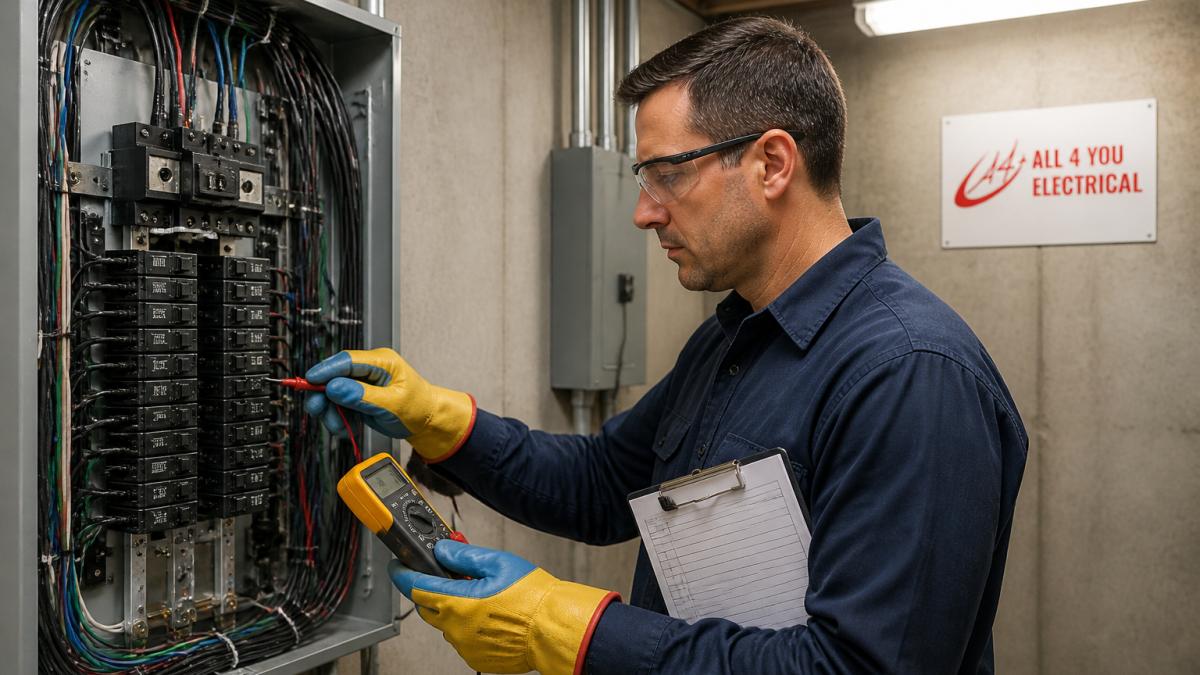
The core items we check on every commercial visit:
- Service entrance and main switchgear: infrared scan for hot terminations, torque check on lugs, signs of corrosion or moisture intrusion
- Distribution panels and breakers: breaker exercise, labeling accuracy, evidence of nuisance tripping or scorching
- Branch circuits and receptacles: load testing, GFCI function, damaged or overheated devices
- Grounding and bonding: continuity at the service and at subpanels, intact ground paths
- Emergency and exit lighting: battery function and illumination under test conditions
- Motors and HVAC disconnects: amperage draw compared to nameplate rating, disconnect condition
A common mistake is treating the checklist as a one-time audit. It is a recurring document. Items get added as your building changes, and that is the point.
Building a Preventive Electrical Maintenance Plan
A preventive electrical maintenance plan is a written schedule that assigns each inspection task an owner, a frequency, and a record. The plan itself is simple. Keeping it alive is the hard part.
Start by mapping your building. Note the service size, panel locations, major motor loads, and any equipment that cannot tolerate an unplanned outage. Then group tasks by how often they need attention, and decide who performs each one. Some visual checks, like confirming exit lights illuminate, are reasonable for your own staff. Anything involving an open panel, a torque wrench, or a thermal camera belongs to a licensed electrician.
Tie your inspection frequency to load changes, not just the calendar. Every time you add a large load, such as a commercial kitchen appliance or a bank of Level 2 chargers, have the affected panel evaluated within 30 days. New load is where old panels fail first.
Write the plan so a new property manager could pick it up and run it without asking you questions. If it only lives in one person’s head, it is not a plan.
Electrical Maintenance Schedule for Commercial Buildings
An electrical maintenance schedule for commercial buildings typically runs on three tiers: monthly, quarterly or semiannual, and annual. The right cadence depends on your building’s age, load profile, and occupancy, so treat the table below as a starting framework rather than a fixed rule.
| Frequency | Typical Tasks | Who Performs It |
|---|---|---|
| Monthly | Visual check of panels, exit and emergency lighting test, log review | On-site staff |
| Quarterly | Receptacle and GFCI testing, breaker exercise, infrared scan of high-load panels | Licensed electrician |
| Annual | Full torque check, grounding verification, service entrance inspection, load study | Licensed electrician |
Older buildings and high-load facilities generally move everything up a tier. A building with heavy motor loads or continuous operation may need semiannual infrared scanning rather than annual. Many property managers find that the first year of a new plan surfaces the most issues, then the schedule settles into a predictable rhythm.
Electrical Maintenance Log Template: What to Record
An electrical maintenance log template is a structured record of every inspection, repair, and load change, organized so you can prove what was done and when. The log is your defense when an insurer, inspector, or buyer asks questions.
Use this format for each entry:
- Date and time of the inspection or repair
- Panel or circuit identifier, matching your building map
- Task performed and the specific checklist item it satisfies
- Findings, including temperature readings or amperage values where measured
- Corrective action taken, or the work order number if deferred
- Name and license number of the electrician who performed the work
- Follow-up date if the item needs rechecking
Skipping the log does not just create paperwork problems. If a fire or injury investigation traces back to a known, unrecorded deficiency, the absence of documentation works against you. Record the finding even when you defer the repair.
Keep the log in one place, physical or digital, and back it up. A log scattered across email threads is not a log.
Choosing a Qualified Electrical Contractor
Choosing a qualified electrical contractor comes down to three checks: licensing, insurance, and a clear scope of work in writing. Everything else is preference.
Ask for the license number and verify it. Confirm general liability and workers’ compensation coverage before anyone opens a panel on your property. Then ask how the contractor handles documentation, because a contractor who leaves you a clean inspection report is worth more than one who only leaves an invoice.
At All 4 You Electrical, we are a family-owned team that has served commercial clients for over a decade, and we provide free estimates upfront so you know the scope before you commit. We also leave the property clean after service, which matters more than people expect when work happens inside an occupied building.
Property managers running multiple commercial sites who need one contractor for both scheduled maintenance and emergency response.
A note on switching contractors: the most common reason property managers tell us they change providers is not price. It is responsiveness. A contractor who answers when a panel is down is worth a longer relationship than one who saves a few dollars per visit.
Conclusion
The hardest part of commercial electrical maintenance is not the technical work. It is consistency: keeping the schedule, filling in the log, and treating new loads as a reason to re-inspect rather than a reason to hope. Most failures we see were visible months earlier to someone who was looking.
All 4 You Electrical can take that consistency off your plate. Our team brings over a decade of commercial experience, free upfront estimates, and a commitment to leaving your property clean after every visit. Contact us to schedule an inspection or build a maintenance plan for your building.
Frequently Asked Questions
What does commercial electrical maintenance include?
Commercial electrical maintenance covers inspection, testing, and servicing of all electrical components in a business. This includes panels, wiring, outlets, lighting, motors, and safety devices like ground-fault circuit interrupters. Technicians check for code compliance, tighten connections, test voltage and current, and identify wear or hazards. A thorough commercial electrical system maintenance guide recommends documenting every step and scheduling regular service to prevent downtime and costly repairs.
How often should a commercial electrical system be inspected?
Most commercial electrical systems should be inspected annually by a licensed electrician. High-use facilities like restaurants or manufacturing plants may need quarterly or semi-annual inspections. The electrical maintenance schedule for commercial buildings should also account for local codes and insurance requirements. Regular inspections catch issues early, reduce fire risk, and keep your business running safely.
What are the signs that a commercial electrical system needs maintenance?
Warning signs include flickering lights, frequent circuit breaker trips, burning odors, discolored outlets, buzzing sounds, and warm switch plates. If you notice any of these, call a qualified electrician immediately. Ignoring these signs can lead to equipment damage or fire. A preventive electrical maintenance plan helps you spot these issues during routine checks before they become emergencies.
Who is qualified to perform commercial electrical maintenance?
Only licensed electricians should perform commercial electrical maintenance. In most states, this means a master or journeyman electrician with specific commercial experience. Verify their license, insurance, and references. For specialized systems like fire alarms or emergency generators, additional certifications may be required. Always ask for proof of qualification before allowing any work on your electrical system.
What records should businesses keep for electrical maintenance?
Keep a detailed electrical maintenance log template that includes dates of service, names of technicians, specific tasks performed, test results, and any repairs or replacements. Also retain inspection reports, warranty documents, and code compliance certificates. These records help track system history, demonstrate due diligence, and support insurance claims if an incident occurs. Good records also make it easier to plan future maintenance.