Table of Contents
- EV Charger Installation in Meridian Idaho: What Homeowners Need to Know
- EV Charger Electrical Requirements: Level 1 vs Level 2 and Your Panel
- Meridian Permits and Code-Compliant Installation
- EV Charger Installation Cost: What Drives the Price
- EV Charger Installation Time: Timeline and Prep Steps
- EV Charger Installer Questions to Ask Before You Hire
- Meridian Home-Specific Installation Considerations
- Frequently Asked Questions
Last Updated: October 16, 2026
EV Charger Installation in Meridian Idaho: What Homeowners Need to Know
Electric vehicle ownership keeps climbing across the Treasure Valley, and new owners ask the same question: how do I get ev charger installation meridian in Idaho without tearing up my electrical system?
Most homes need a Level 2 charging station on a dedicated 240-volt circuit, a panel that can carry the extra load, and a city permit before anyone touches a wire.
A home charger is only as good as the circuit behind it. The equipment is the easy part; the electrical assessment decides whether your project is a one-day job or a panel upgrade.
EV Charger Electrical Requirements: Level 1 vs Level 2 and Your Panel
EV charger electrical requirements start with one decision: Level 1 or Level 2. Level 1 uses a standard 120-volt outlet and adds only a few miles of range per hour, which suits plug-in hybrids and very low daily mileage.
240V Circuits and What Level 2 Charging Needs
A Level 2 charger needs a dedicated circuit rated for the charger’s amperage, typically 40 to 60 amps on a 240V line. Sharing a circuit with a dryer or workshop outlet invites tripped breakers and overheated wiring. Hardwired units often allow a higher amperage setting; a plug-in unit on a NEMA 14-50 outlet is easier to swap later.
Panel Capacity Checks and Load Calculations
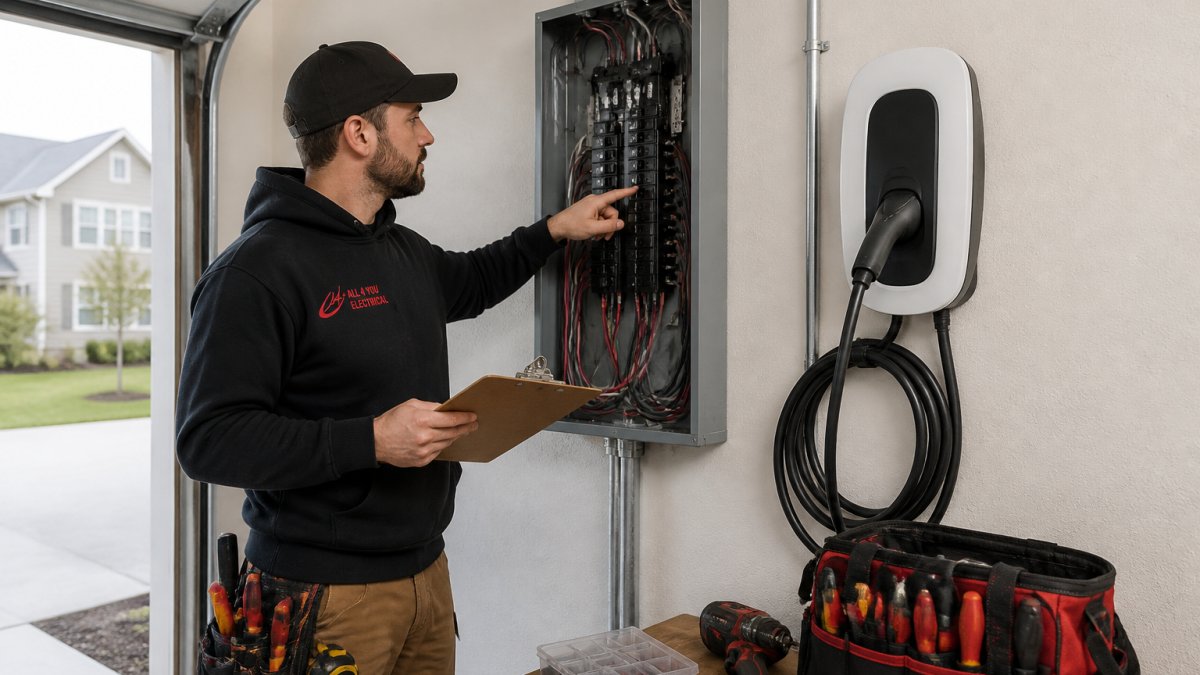
Before quoting anything, a licensed electrician runs a load calculation on your panel, adding up existing demand and checking whether the charger fits within your service capacity. Older homes with 100-amp service often cannot absorb a 48-amp charger without an upgrade; 200-amp service usually can. If your panel is full or undersized, the options are a panel upgrade, a lower-amperage charger, or a load management device that pauses charging when household demand peaks.
| Charging Level | Voltage | Typical Circuit | Best For |
|---|---|---|---|
| Level 1 | 120V | Standard outlet | Low daily mileage, plug-in hybrids |
| Level 2 | 240V | 40-60A dedicated | Full EVs, overnight charging |
Meridian Permits and Code-Compliant Installation
Meridian requires an electrical permit for EV charger installation, and the work must pass inspection before the circuit is legal. Skipping the permit saves a small fee and creates a large problem: unpermitted work surfaces during home sales, insurance claims, and future inspections.
Who Issues the Permit and What the Application Needs
Permitting runs through the City of Meridian’s Building and Permitting Division, which administers the adopted electrical code. A residential EV charger permit is typically filed as an electrical permit for a new dedicated branch circuit for electric vehicle supply equipment. The application asks for:
- Property address and owner of record
- Contractor license number and the electrician’s name
- Description of work: circuit amperage, voltage, wire type, and charger model
- A simple site plan or sketch showing panel location and charger location
Most jurisdictions of this size issue residential electrical permits over the counter or online, with review measured in business days. Confirm current fees and turnaround before you schedule installation day, because the permit must be issued before the circuit is energized.
What the Inspection Actually Checks
A residential EV charger inspection is usually a single visit after the work is complete and the circuit is live. Common checkpoints:
- Correct breaker size and type for the charger’s rated amperage
- Conductor sizing matched to the overcurrent device and the run length
- Proper grounding and bonding of the equipment
- GFCI protection where the code edition in effect requires it for the circuit
If the inspector finds a defect, the usual path is a correction notice, a fix, and a re-inspection. A reputable installer builds that into the schedule.
The Code Behind the Work
The National Electrical Code, published as NFPA 70, is the model electrical code that states and local jurisdictions adopt, often with amendments and often a code cycle or two behind the newest edition. Article 625 covers electric vehicle power transfer systems and is the section that governs conductor sizing, disconnecting means, and personnel protection for charging equipment. The National Fire Protection Association’s overview of NFPA 70 explains how the code is structured and why it is updated on a three-year cycle.
A Proper Installation Follows a Predictable Path
- Site assessment and load calculation
- Permit application with the city
- Permit issued and posted or available on site
- Circuit run, breaker, and charger mounting
The most common shortcut we see is a homeowner hiring a handyman to “just run a 240 line.” Unpermitted, uninspected work can void insurance coverage on a fire claim and must be disclosed, and often corrected, at resale. It can also leave you with a circuit that fails a load calculation you never had performed.
The permit is not paperwork for its own sake. It is the mechanism that forces a load calculation, a code-compliant circuit, and an independent set of eyes on the work before your vehicle is plugged into it every night.
EV Charger Installation Cost: What Drives the Price
EV charger installation cost depends far more on your electrical system than on the charger itself. Equipment is a fixed purchase; labor and materials vary with distance from the panel, wall type, and whether your service can handle the new load. Below are ranges rather than a single number, because a quote that does not account for your panel is a guess.
Equipment: The Charger Itself
A Level 2 home charger is the smallest line item in most projects. Basic 32-amp to 40-amp units commonly sell for $400 to $800, while higher-amperage hardwired units with smart features, load sharing, or Wi-Fi scheduling run roughly $700 to $1,300. Level 1 charging requires no equipment beyond the cord that ships with the vehicle.
Labor and Materials: The Circuit
This is where the estimate swings. A straightforward attached-garage install with the panel nearby is the low end. A long run through finished walls, a detached garage, or conduit and trenching pushes it up. Typical labor and materials for a dedicated 240-volt circuit commonly land in the $800 to $2,500 band depending on run length, wall construction, and whether the unit is hardwired or on a NEMA 14-50 outlet.
Panel Upgrades and Load Management
If the load calculation fails, the project changes shape. A full service upgrade, including a new panel, meter work, and utility coordination, is the largest single cost driver and commonly runs into the low thousands of dollars. A load management device is the middle path and usually a fraction of an upgrade, but only works when the existing service is sound.
Permit and Inspection Fees
Permit fees are set by the jurisdiction and scale with the declared value of the work. For a residential electrical permit of this size, expect a fee in the low hundreds of dollars, usually folded into the contractor’s estimate.
| Cost Component | Typical Range | Notes |
|---|---|---|
| Level 2 charger | $400 – $1,300 | Amperage and smart features drive the spread |
| Circuit labor and materials | $800 – $2,500 | Run length and wall type are the biggest variables |
| Panel upgrade | Low thousands | Only if the load calculation fails |
| Load management device | Fraction of an upgrade | Requires sound existing service |
| Permit and inspection | Low hundreds | Set by the jurisdiction |
Incentives and Tax Credits
Federal tax credits for home charging equipment and installation have existed in various forms and have changed with each tax year, so the amount and eligibility rules are worth confirming for the year you install rather than assuming last year’s rules apply. The U.S. Department of Energy’s information on electric vehicle charging at home is a reasonable starting point for how equipment is rated and what programs exist.
Why We Quote After We See the Panel
Because every home is different, we give free upfront estimates so you know the scope before work begins. A phone quote that ignores your service size, open breaker spaces, and distance to your garage is not an estimate; it is a placeholder.
Ask any installer to separate the estimate into equipment, circuit labor, permit, and any panel work. A single lump-sum number hides which line item is driving the price and makes it impossible to compare bids fairly.
EV Charger Installation Time: Timeline and Prep Steps
EV charger installation time is usually a single day for a straightforward garage install with adequate panel capacity. Add a panel upgrade or a long circuit run and the project stretches across two or more visits.
A realistic timeline:
| Phase | Typical Duration | What Happens |
|---|---|---|
| Site assessment | Same-week visit | Load calculation, routing plan, written estimate |
| Permit filing | A few business days | City review and approval |
| Installation day | One day, most homes | Circuit, breaker, mounting, testing |
| Inspection | Scheduled after install | City sign-off |
How to prepare:
- Clear the path from the panel to the charger location.
- Note your daily driving distance and your EV’s onboard charger limit.
- Decide between hardwired and plug-in before the assessment.
- Ask about the permit timeline, since it can shift your install date.
EV Charger Installer Questions to Ask Before You Hire
EV charger installer questions matter because the cheapest bid is often the one that skips the load calculation or the permit. Ask these before you commit:
- Are you licensed to perform electrical work in Idaho?
- Will you pull the permit, or is that on me?
- Will you run a load calculation before quoting?
- What happens if the inspection fails?
- Is the estimate firm, and what could change it?
- Do you handle panel upgrades in-house?
A contractor who hesitates on the permit question is telling you something. So is one who quotes without seeing your panel.
Ask for the estimate in writing with the scope spelled out: circuit size, wire type, permit responsibility, and cleanup. Verbal quotes are where surprise charges hide.
Meridian Home-Specific Installation Considerations
Meridian homes vary enough that a template approach fails. Newer construction often has 200-amp service and an attached garage, which makes installation straightforward.
For property managers overseeing multiple rental units, a single assessment can map which buildings can take a charger now and which need service upgrades first. U.S. Department of Energy guidance on home charging is a useful starting reference for how charging equipment is rated and installed.
If you want an installer who shows up when promised, leaves the garage cleaner than we found it, and stands behind the work, that is the standard we hold ourselves to.
Charging at home should be the easiest part of owning an EV, and it will be if the electrical work is done right the first time.
Frequently Asked Questions
Do I need a permit to install a home EV charger in Meridian?
Yes. A dedicated 240-volt circuit and EV charging equipment generally require an electrical permit and inspection in Meridian. A licensed electrician pulls the permit, completes the wiring, and schedules the inspection so the work meets current electrical code. Skipping the permit can create problems at resale and may void insurance coverage if something goes wrong. All 4 You Electrical handles permitting and inspection as part of every EV charger installation.
What should I ask an electrician before hiring them for EV charger installation?
Ask four things: whether they hold a current electrical license, whether the permit and inspection are included, how they’ll run the circuit and where the charger will mount, and whether they’ll do a load calculation before quoting. Also ask about cleanup and whether the estimate is free and itemized. A written, upfront estimate with no surprise charges is a fair expectation for any EV charger installation in Meridian Idaho.
How long does professional EV charger installation take?
Most straightforward Level 2 installations take a few hours on site once the permit is approved. If your panel needs an upgrade or the run from the panel to the garage is long, plan for a full day or more. Add time for the permit review and the inspection. Scheduling around material availability can also shift the EV charger installation time, so ask for a realistic window rather than a same-day promise.
Does installing an EV charger require an electrical panel upgrade?
Not always. A load calculation determines whether your existing panel can handle the added 240-volt circuit. Older homes with 100-amp service often need an upgrade, while many 200-amp panels have room. A licensed electrician can also use load management devices to share capacity without a full upgrade. Only a proper load calculation tells you which path applies to your Meridian home.