Last Updated: November 14, 2026
Quick Summary
Panel upgrade safety depends on replacing or expanding service equipment with listed products, a load calculation that matches real demand, and permitted, inspected work. Electrical panel upgrade safety standards in the United States are set mainly by the National Electrical Code, as adopted by your local jurisdiction.
- Check which NEC edition and local amendments your jurisdiction enforces before work begins.
- Look for a recognized testing laboratory mark on the panel, breakers, and enclosure.
- Base the service size on a load calculation, not on the existing breaker labels.
- Keep the working space in front of the panel clear of storage and furniture.
- Confirm the utility approves the new service size before the meter is reconnected.
Table of Contents
- Recognized hazards in older panels
- Electrical Codes and Safety Standards That Apply
- 100 Amp to 200 Amp Panel Upgrade: Capacity and Load Requirements
- Electrical Panel Clearance Requirements for Safe Access
- Electrical Panel Labeling Requirements and Circuit Directories
- Electrical Panel Upgrade Permits and Inspections, Step by Step
- Planning Your Panel Upgrade Safely With All 4 You Electrical
- Frequently Asked Questions
Most homeowners only think about their electrical panel when a breaker trips or a light flickers. Panels that have been quietly overloaded for years are a common finding during electrical work. An electrical panel upgrade is the replacement or expansion of the main service equipment that distributes power through your home, and panel upgrade safety becomes a concern when the existing panel can no longer handle the load placed on it.
Recognized hazards in older panels
Older panels carry risks that are easy to overlook. Corroded connections, scorched bus bars, and panels with missing knockouts or doubled-up breakers are other warning signs. If breakers keep tripping, learn why a circuit breaker trips repeatedly and how to fix it. Many homeowners find that the first real evidence of a problem is a warm panel cover or a faint burning smell, which should prompt an immediate inspection by a licensed electrician.
When a panel upgrade is required
A panel upgrade is usually required when the home’s service capacity no longer matches its electrical demand. Adding central air conditioning, an EV charger, a hot tub, or a finished basement can push a 100-amp service past its practical limit. Frequent breaker trips, the need for fuses in place of breakers, or a panel that is no longer manufactured and cannot be fully serviced are also common reasons. Use this checklist of warning signs that your electrical panel needs an upgrade to confirm your decision.
Electrical Codes and Safety Standards That Apply
Electrical panel work in the United States is governed primarily by the National Electrical Code (NEC), published by the National Fire Protection Association and adopted into law by states and local jurisdictions. Equipment is expected to be listed by a recognized testing laboratory, such as UL, to show it meets the applicable product safety standards. Because the NEC is a model code, the edition your jurisdiction enforces and any local amendments determine what your contractor must do.
How code editions and local amendments differ
Each jurisdiction adopts a specific NEC edition, often several years behind the most recent release, and then modifies sections to suit local conditions. One city may require additional labeling or working clearance that a neighboring county does not. Before any work begins, ask your local building department which edition and amendments apply to your project. For a deeper walkthrough, see how to get electrical upgrade permits for homeowners.
Listed equipment and testing laboratory marks
Look for a recognized testing laboratory mark on the panel, breakers, and enclosure. A listing mark confirms the product was tested against a safety standard, and the NEC requires listed equipment for most installations. Mixing breakers from different manufacturers in a panel not designed for them is a common installation error that can compromise the listing and the protection the panel is supposed to provide.
100 Amp to 200 Amp Panel Upgrade: Capacity and Load Requirements
A 100-amp service is often adequate for a smaller home with gas heating, gas cooking, and a few large appliances. It becomes marginal once you add central air conditioning, an electric range, a hot tub, a shop, or an EV charger. A 200-amp service is the common target for a modern single-family home, but the correct size is determined by a load calculation, not by habit.
How the load calculation works
The NEC provides a standardized method for calculating a dwelling’s service load. When the calculated load approaches the service rating, the scope of the work depends not only on the added demand but also on factors affecting upgrade costs, such as the condition of existing equipment and wiring.
Watch out: a calculation based on the current panel’s breaker labels alone is unreliable, because labels are often wrong or outdated. The calculation should reflect what is actually connected and what is planned.
Service equipment, meter, and utility coordination
Increasing the panel rating is only part of the job. The service entrance conductors, meter base, main disconnect, and grounding electrode conductor must all be rated for the new service. In many homes the existing meter base and service drop were sized for 100 amps and must be replaced. The utility owns the service drop or lateral up to the point of attachment, so the utility must approve the new service size and schedule the disconnect and reconnect.
When a full service change is needed
A panel replacement that keeps the existing service size is a smaller project than a service change that increases amperage. A service change typically involves new service conductors, a new meter base, a new grounding electrode system, and coordination with the utility. If the goal is only to replace a failing panel of the same rating, the load calculation still matters, because it confirms the existing service is adequate for the home’s actual demand.
Electrical Panel Clearance Requirements for Safe Access
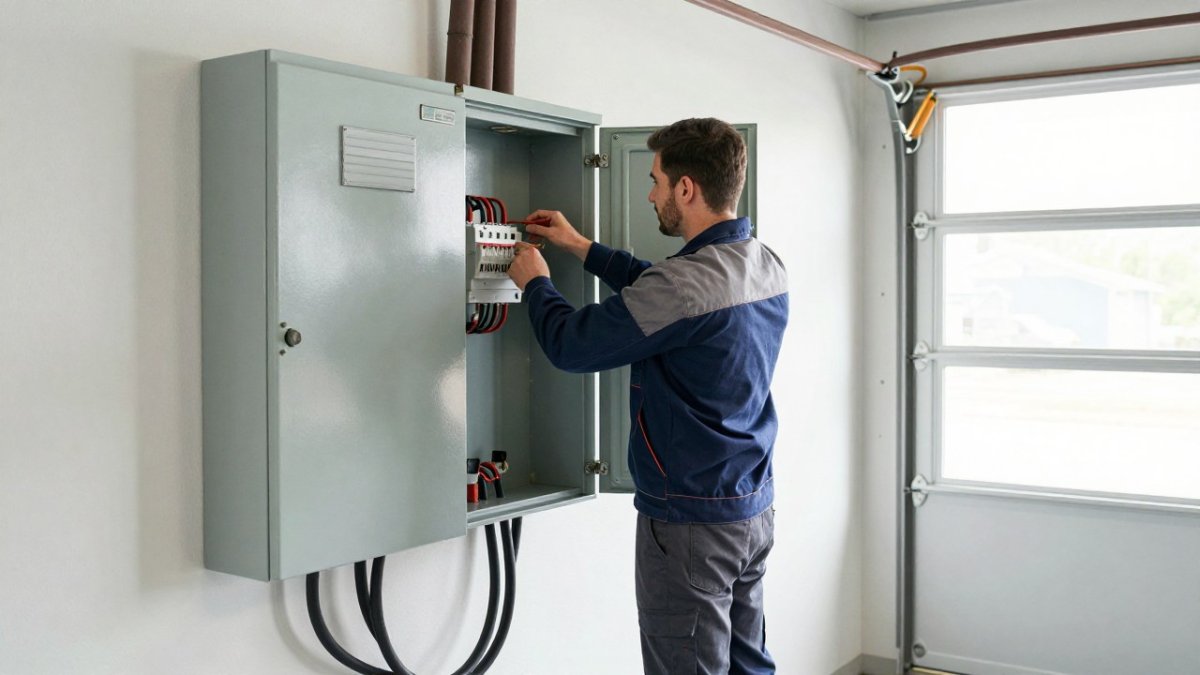
The NEC requires a dedicated working space in front of every panel, along with a dedicated equipment space above and around it. These are two separate requirements, and both are commonly violated in finished basements and closets.
Working space in front of the panel
The NEC sets minimum dimensions for the working space in front of a panel, including width, height and depth. Confirm the exact figures for your jurisdiction’s adopted edition with your inspector. The space must be clear of storage, shelving, furniture, and anything else that would block a person working on the panel. The width is measured side to side and must allow the panel door to open fully.
Dedicated equipment space
Above and around the panel, the code reserves a space for the equipment itself. The code reserves a dedicated equipment space above and around the panel, which should be kept free of unrelated pipes and ducts. A water heater or plumbing line installed directly above a panel is a hazard, because a leak can run into the enclosure.
Practical examples and common mistakes
- A panel installed in a closet that is later filled with coats and boxes fails the working-space requirement even though the panel itself is fine.
- A panel mounted behind a water heater or furnace cannot be serviced safely and may not pass inspection.
- A panel recessed into a wall with a shelf built across the front violates the clear-space rule.
Watch out: clearance is measured from the face of the panel, not from the wall, and inspectors measure it. If you are planning a basement finish or a closet build-out around an existing panel, confirm the dimensions before framing.
Why this matters beyond inspection
A clear working space is what allows an electrician to de-energize the panel safely, test for voltage, and reach the main breaker in an emergency. It also makes routine work faster and less likely to result in an accidental contact. Keeping the area clear is one of the few safety requirements a homeowner can maintain on their own after the upgrade is complete.
The working space and equipment space requirements are summarised below.
| Requirement | What it covers | Note |
|---|---|---|
| Working space in front | Clear space for access to the panel | Measured from the face of the panel |
| Dedicated equipment space | Area above and around the panel | Keep free of unrelated pipes and ducts |
| Closet placement | Panel in a closet with stored items | Fails the working-space requirement |
| Water heater above panel | Plumbing directly over the enclosure | Leak can run into the enclosure |
| Outdoor panel location | Snow or irrigation water collection | Must be rated for the location |
Electrical Panel Labeling Requirements and Circuit Directories
Clear labeling is part of a safe panel. Each breaker should identify the circuit it controls, and the directory should be legible and accurate after the work is complete. Labeling makes emergency shutoffs faster and reduces the risk of someone energizing the wrong circuit during maintenance. Ask your electrician to update the directory as part of the final walkthrough.
Electrical Panel Upgrade Permits and Inspections, Step by Step
Most panel upgrades require a permit, and the work must pass inspection before the utility will reconnect power. A typical process looks like this:
- Confirm with the local building department which permits and code edition apply.
- Have your licensed electrician prepare the load calculation and equipment specifications.
- Submit the permit application with the plan.
- Schedule the utility disconnect and reconnect coordination.
- Complete the installation and request the required inspection.
- Keep the inspection approval and permit records for insurance and future sales.
Permit timelines and fees vary by jurisdiction, so check with your local office for current requirements.
Planning Your Panel Upgrade Safely With All 4 You Electrical
Planning a panel upgrade is easier when you know what questions to ask. All 4 You Electrical offers free upfront estimates. If you’re weighing a 100-amp to 200-amp upgrade, book a panel upgrade estimate to get a load assessment and a clear scope before committing to anything. You can also review the signs your electrical panel needs an upgrade to decide whether now is the right time.
Frequently Asked Questions
What safety standards apply to a residential electrical panel upgrade?
Most residential panel upgrades in the United States fall under the National Electrical Code (NEC), which is published by the National Fire Protection Association as NFPA 70. Your state and local jurisdiction adopts a specific edition of the NEC, often with local amendments, so the version enforced where you live controls. Panel equipment should be a listed product tested to standards such as UL 67 for panelboards. Your electrician should confirm which edition applies before work begins.
Does an electrical panel upgrade need a permit and inspection?
In most areas, replacing or upgrading a main electrical panel requires an electrical permit and a final inspection by the local building or electrical authority. The permit confirms that the work is reviewed against the adopted code, and the inspection verifies grounding, bonding, wire sizing, and overcurrent protection. Permit requirements vary by city and county, so check with your local building department before you start. A licensed electrician usually pulls the permit as part of the job.
What clearance is required around an electrical panel?
The NEC requires a minimum working space in front of electrical equipment, with headroom clearance that depends on the equipment and voltage. The space must be kept free of storage, stored items, and obstructions so that someone can reach the panel safely in an emergency. Exact dimensions depend on the code edition adopted locally, so confirm them with your inspector. Keeping shelves, bikes, and boxes away from the panel is one of the simplest safety steps homeowners can take.
What labels are required on an electrical panel?
The NEC requires panelboards to be marked with their voltage, current rating, and manufacturer information, and it calls for a circuit directory that identifies what each breaker controls. The directory should be legible, durable, and located on or near the panel. Labels for hazards such as multiple power sources are also required where applicable. Keep the directory current after any change to circuits, because an accurate label helps firefighters and electricians work safely during an emergency.
Can I upgrade my electrical panel from 100 amps to 200 amps?
Yes, a 100 amp to 200 amp panel upgrade is common in homes that have added large loads such as central air conditioning, electric ranges, EV chargers, or a heat pump. Before upgrading, a licensed electrician should perform a load calculation under the NEC to confirm the service size you need. The upgrade typically involves coordinating with your utility for the service drop or meter work, and it almost always requires a permit and inspection. Pricing depends on service conditions, so request a written estimate from All 4 You Electrical for your home.
How can I tell whether my electrical panel needs an upgrade?
Signs that a panel may need replacement include breakers that trip frequently, fuses or breakers that feel warm, a burning smell or scorch marks near the panel, flickering lights, and a panel brand that is known to have listed defects. Older panels may also lack modern overcurrent protection or have limited capacity for new loads. An electrician can inspect the panel, check its condition, and run a load calculation to determine whether replacement is the safest option.
Who should do an electrical panel upgrade?
Panel upgrades involve energized equipment, utility coordination, and code-compliant work, so they should be performed by a licensed electrician. Licensed electricians are familiar with the adopted NEC edition, know how to pull permits, and can schedule inspections. Ask for proof of license and insurance, a written estimate, and confirmation that the permit will be handled. All 4 You Electrical offers free upfront estimates for panel upgrades in Boise and Meridian.
