
Table of Contents
- What Affects Residential Generator Installation Cost
- Whole-House Generator Installation Cost Breakdown
- Whole-House Generator Sizing and Power Requirements
- Fuel Type and Fuel Connection Costs
- Standby Generator Maintenance Cost and Long-Term Ownership
- Getting an Accurate Installation Quote
- Frequently Asked Questions
Last Updated: October 12, 2026
What Affects Residential Generator Installation Cost
The cost to install a whole-house generator varies based on several key factors. Understanding what drives pricing helps you budget accurately and avoid surprises when you get quotes from local electricians.
Generator size matters most. A smaller unit costs less to purchase and install than a larger one.
Local permitting and inspection add to the bill. Some areas require multiple inspections. Permit fees vary by jurisdiction. Your electrician must pull permits and ensure all work meets local electrical codes.
Each installation is unique, which is why we provide free upfront estimates so you know exactly what to expect.
Whole-House Generator Installation Cost Breakdown
The table below shows how a typical whole-house standby installation splits across line items, followed by what drives each one up or down.
| Line item | Typical share of total | What moves the number |
|---|---|---|
| Generator equipment | 35-50% | Kilowatt rating, brand tier, air-cooled vs. liquid-cooled |
| Automatic transfer switch (ATS) | 5-10% | Service rating (100A vs. 200A vs. 400A), smart vs. standard |
| Electrical rough-in and connections | 10-20% | Panel condition, conduit run length, whether a panel upgrade is needed |
| Fuel connection | 5-15% | Natural gas vs. propane, trench length, meter capacity |
| Concrete pad and site prep | 3-8% | Soil, slope, drainage, distance from house |
| Permits and inspections | 2-5% | Jurisdiction fee schedule, number of inspection stages |
| Startup, load test, commissioning | 2-5% | Whether the installer performs a full transfer test under load |
Equipment and Purchase Price
The generator itself is your largest single expense, and the spread between a 10 kW air-cooled unit and a 26 kW liquid-cooled unit reshapes the whole budget.
Standby generators are permanently installed outside your home, run on natural gas or propane, and start automatically when utility power drops. Portable generators cost far less upfront but require manual setup, a manual transfer switch, and someone home to connect them, many homeowners treat a portable as a stopgap before upgrading to standby.
Ask your installer to quote the equipment line separately from labor.
Generator Installation Labor Cost
Labor is the second-largest line and the most sensitive to site conditions. Licensed electricians bill for time to set the unit, run fuel and electrical connections, commission the system, and document the install for the permit file.
Installation labor typically includes:
- Setting the generator on its pad and leveling it
- Running fuel lines from the gas meter or propane tank
- Pulling conduit and wiring from the generator to the transfer switch and panel
- Terminating and torquing all electrical connections
- Performing a transfer test under load and documenting results These technical requirements often reveal that the existing service entrance is insufficient, necessitating an electrical panel replacement to safely accommodate the new power load.
A straightforward install on a prepared site with a modern 200A panel takes far less labor than one requiring a panel upgrade, a long conduit run, or trenching through rocky soil. That’s why two neighbors with the same generator can receive quotes that differ by thousands of dollars.
Transfer Switch and Electrical Work
The transfer switch prevents your generator from backfeeding the utility grid and injuring line workers.
Automatic transfer switches (ATS) monitor utility power continuously and start the generator within seconds of an outage. Manual transfer switches cost less but require you to be home and physically flip the switch.
Installing the transfer switch involves:
- Confirming your service panel can accept the switch (or upgrading it)
- Running conduit and conductors from the generator to the switch
- Wiring the switch to the circuits you want backed up
- Installing disconnects, breakers, and grounding per code
- Testing every connection under load
If your home has a 100A service panel or a panel made by a brand with known breaker-supply issues, budget for a panel upgrade. It’s one of the most common surprise line items on a generator quote.
Site Preparation and Permits
Your generator needs a stable, level foundation. Most manufacturers require a concrete pad or approved composite base sized to the unit, and the pad must drain away from the equipment.
Site preparation tasks include:
- Excavating and compacting the base
- Pouring and finishing the pad
- Trenching for fuel and electrical runs
- Installing conduit and pulling conductors
- Grading for drainage
Permit and inspection fees vary widely by jurisdiction. Your electrician pulls the permit, but you pay the fee.
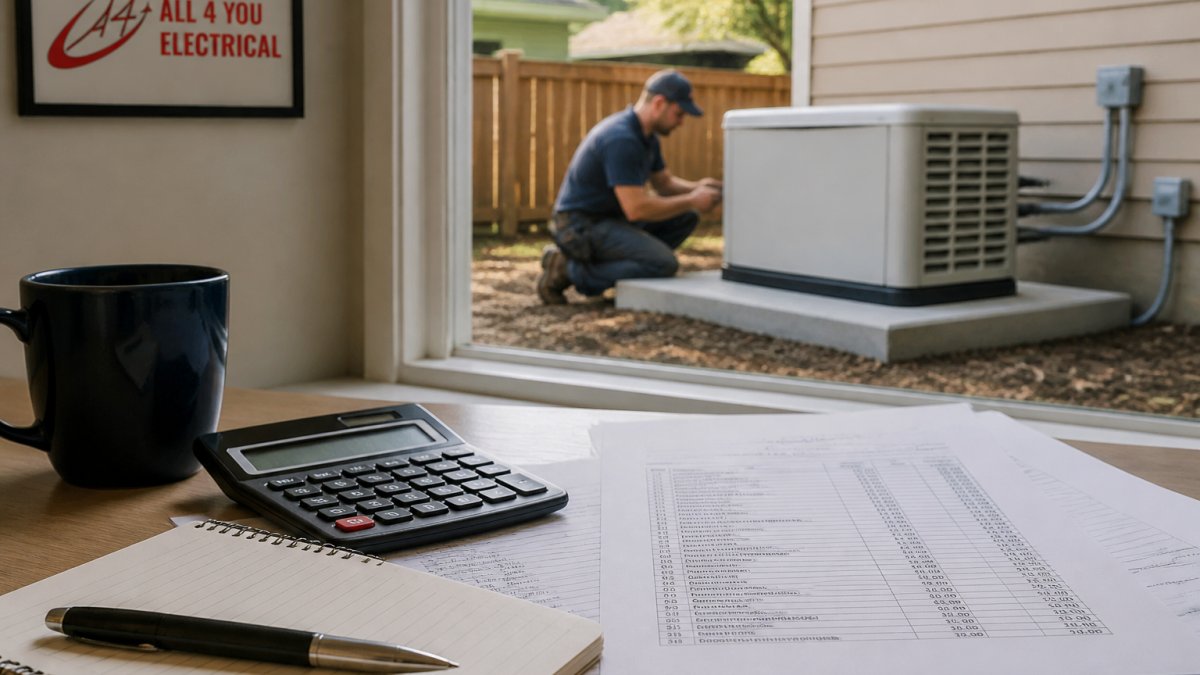
The single most useful thing you can do when comparing quotes is ask each contractor to break their bid into the seven line items above. A quote that can’t be itemized is a quote you can’t compare.
Whole-House Generator Sizing and Power Requirements
Sizing is where most generator projects succeed or fail. An undersized unit trips its breaker the moment your air conditioner and well pump start together. An oversized unit costs more upfront, burns more fuel at light load, and may require a larger gas meter or service upgrade you didn’t budget for.
Square footage is a starting point, not an answer. Two 2,000-square-foot homes can land on very different kilowatt ratings depending on what the owners want to keep running.
Start With What You Want to Back Up
The first decision is coverage level, not kilowatts:
- Essential circuits only, refrigerator, freezer, sump pump, well pump, furnace blower, a few lights and outlets, internet router. This is the smallest and cheapest path.
- Essential plus comfort, adds central A/C, more lighting, and larger appliances. Requires a meaningfully larger unit.
- Whole-home, everything, including electric range, electric water heater, and electric heat. This is the largest and most expensive path and often requires a service or meter upgrade.
Write down the specific appliances and systems you want on backup power before you talk to a contractor. That list drives everything else.
How a Load Calculation Actually Works
A licensed electrician performs a load calculation using the methodology in the National Electrical Code (NFPA 70) and Article 220. The process, simplified:
- Inventory the loads. Every motor, heating element, and continuous load on the circuits you want backed up gets listed with its running watts and, for motors, its starting watts.
- Apply demand factors. Not everything runs at once. The calculation applies demand factors to lighting, receptacles, and ranges so the total reflects realistic simultaneous use rather than the sum of every nameplate.
- Add the largest motor’s starting surge. Air conditioners, well pumps, and furnaces draw two to three times their running wattage for a few seconds at startup. The generator must absorb that surge without tripping.
- Compare to generator ratings. Manufacturers publish both running (continuous) and starting (surge) ratings. The generator must exceed both, with margin.
Ask your contractor to show you the load calculation worksheet, not just the recommended kilowatt number. A one-page worksheet that lists each appliance and its running and starting watts tells you whether the recommendation is grounded or guessed.
The Oversizing and Undersizing Trade-Offs
Undersizing shows up as nuisance tripping, the generator starts, the A/C kicks on, and the breaker trips. It also causes voltage sag that can damage electronics and shorten the generator’s life.
Oversizing costs more in three ways: higher equipment price, higher fuel consumption at light load, and potentially a larger gas meter or service upgrade to feed the unit. An oversized unit may also require a larger concrete pad and more clearance from the house.
A common pattern is to size for the essential-plus-comfort tier rather than whole-home.
How Sizing Feeds Back Into Cost
Sizing is not a separate line item, it cascades through the entire quote:
- Larger generator → higher equipment cost
- Larger generator → larger transfer switch and heavier conductors
- Larger generator → higher fuel demand, which may require a gas meter upgrade or a larger propane tank
- Larger generator → larger pad and more clearance
That’s why the sizing conversation should happen before you compare quotes. If two contractors recommend different kilowatt ratings, they’re effectively quoting two different projects.
Bring a written list of the appliances you want backed up to every estimate. Contractors who size from a list will give you comparable quotes; contractors who size from square footage alone will not.
Fuel Type and Fuel Connection Costs
Your generator runs on natural gas, propane, or diesel, each with different connection requirements and long-term operating costs.
Natural gas generators connect to your home’s existing gas line. If you already have natural gas service, connection costs are minimal.
Propane generators require a dedicated tank on your property, with delivery and refilling you must arrange. Tank size affects backup power duration, larger tanks mean longer operation between refills.
Diesel generators offer high fuel efficiency but require diesel storage and regular maintenance. They’re less common for residential use than natural gas or propane.
Fuel connection work includes:
- Running fuel lines from your supply to the generator
- Installing safety shutoff valves and regulators
- Pressure testing all connections
- Ensuring compliance with local gas codes
Standby Generator Maintenance Cost and Long-Term Ownership
Your generator installation cost is just the beginning. Ongoing maintenance and eventual repairs are part of generator ownership.
Annual maintenance keeps your generator reliable. Technicians change oil, inspect belts and hoses, test battery systems, and run the generator under load.
Maintenance tasks include:
- Oil and filter changes
- Spark plug inspection and replacement
- Battery testing and replacement if needed
- Fuel system inspection
- Load testing to verify output
Scheduling annual maintenance before winter is wise. You want your generator in peak condition when power outages are most likely.
Repairs happen when components fail. Transfer switches, fuel lines, and generators occasionally need service, and the longer you own your generator, the more likely repair costs become.
Long-term operating costs depend on fuel type and usage.
Getting an Accurate Installation Quote
The best way to understand your actual generator installation cost is to get quotes from licensed electricians in your area.
What to include in your request:
- Your home’s square footage
- Which appliances and systems you want to back up
- Your preferred fuel type
- Current electrical panel age and capacity
- Site conditions and access to your property
- Timeline for installation
A thorough quote breaks down equipment, labor, electrical work, permits, and site preparation separately, which helps you compare quotes from different electricians.
Red flags in quotes:
- Vague pricing with no breakdown
- Unusually low prices that seem unrealistic
- Refusal to provide a written estimate
- Unclear about permit and inspection costs
At All 4 You Electrical, we provide free upfront estimates with full transparency. You’ll know exactly what you’re paying for before work begins, with no surprise charges later.
Getting multiple quotes from licensed electricians ensures you make an an informed decision.
Frequently Asked Questions
How much does whole-house generator installation cost on average?
Whole-house generator installation cost varies significantly based on generator size, fuel type, site conditions, and local labor rates. Most residential installations include equipment purchase, transfer switch installation, electrical panel work, site preparation, and permits. Costs depend on whether your home needs a natural gas line extended, if concrete pad work is required, and local code requirements. Contact All 4 You Electrical for a free estimate tailored to your specific situation.
What size generator do I need for my home?
Generator sizing depends on your home’s essential circuits and total power needs. Most homes require 10-20 kilowatts for essential circuits like heating, refrigeration, and lighting. Larger homes or those with air conditioning may need 20-48 kilowatts. A professional load calculation identifies which circuits are critical during outages. All 4 You Electrical can assess your home’s power requirements and recommend the right capacity for your backup power needs.
What’s included in generator installation labor cost?
Generator installation labor cost covers the electrician’s time for site assessment, concrete pad preparation, generator placement, fuel connection setup, transfer switch installation, electrical panel modifications, and system testing. Installation complexity varies based on your home’s age, electrical panel capacity, and distance from fuel sources. Professional installation ensures the system meets local code requirements and operates safely during power outages.
How much does standby generator maintenance cost annually?
Standby generator maintenance cost typically includes annual inspections, oil changes, filter replacements, and fuel system checks. Regular maintenance prevents costly repairs and ensures your backup system operates reliably when needed. Maintenance frequency and cost depend on the generator model and usage patterns. All 4 You Electrical offers maintenance services to keep your system in peak condition year-round.
Understanding residential generator installation costs helps you budget and plan for backup power. The final price depends on your generator size, site conditions, electrical upgrades needed, and local permitting requirements. Contact All 4 You Electrical for a free estimate tailored to your home’s specific power needs. Our experienced team will guide you through the process and ensure your generator installation meets all safety standards and local codes.