Last Updated: November 4, 2026
Quick Summary
Electrical upgrade permits are official authorizations from your local building department that let specific electrical work proceed and require inspection before the circuit is energized. In most jurisdictions, only a licensed electrician or the homeowner of an owner-occupied single-family home can pull them.
- Minor replacements like light fixtures, receptacles, and smart thermostats on existing circuits are typically permit-exempt.
- New circuits, panel work, service capacity changes, and meter base work all require a permit.
- A load calculation following Article 220 of the National Electrical Code is required for service upgrades in most jurisdictions.
- The approved permit must be visible on site during work, and rough-in inspection happens before drywall closes wiring.
- Keep the signed inspection card with your closing documents because buyers and insurers ask for proof of permitted work.
Table of Contents
- Why Electrical Upgrade Permits Are Required
- What Electrical Work Can Be Done Without a Permit
- Who Can Pull an Electrical Permit for Homeowners
- How to Apply for an Electrical Permit Step by Step
- Electrical Panel Upgrade Cost and Permit Fees
- The Inspection Process and Electrical Inspection Checklist for Homeowners
- Risks of Skipping Permits: Insurance, Resale, and Safety
- Get a Free Estimate on Your Permitted Electrical Upgrade
- Frequently Asked Questions
Why Electrical Upgrade Permits Are Required
Electrical upgrade permits exist because electrical work can kill you or burn your house down if it goes wrong. That same paper trail matters when an electrical upgrade is part of a larger project, where managing construction permits helps keep inspections and approvals aligned.
Three things make permits non-negotiable:
- Safety. A load calculation, proper grounding and bonding, and correct breaker sizing are code requirements, not suggestions. An unpermitted panel replacement can leave your service entrance undersized for modern demand.
- Code compliance. The National Electrical Code is updated on a three-year cycle, and your local jurisdiction adopts a specific edition. Inspectors check against that edition, not against what was common when your house was built.
- Liability. If unpermitted work causes a fire, your insurer can deny the claim. That risk sits with you, not the electrician who skipped the paperwork.
The permit itself is not the expensive part. The inspection process catches the mistakes that matter.
What Electrical Work Can Be Done Without a Permit
Most jurisdictions allow a short list of minor replacements without a permit, and everything else requires one. The list is shorter than homeowners expect.
Typical permit-exempt work includes:
- Replacing a light fixture or ceiling fan on an existing circuit
- Swapping a receptacle or switch like-for-like
- Replacing a plug-in appliance cord
Everything involving new circuits, panel work, service capacity changes, or the meter base requires a permit, panel replacement, a 100-to-200-amp service upgrade, EV chargers, generator hookups, and new wiring for an addition. When in doubt, call your building department and describe the job.
Who Can Pull an Electrical Permit for Homeowners
In most jurisdictions, only a licensed electrician or the homeowner of a single-family home they occupy can pull an electrical permit. That second option is where people get into trouble.
A homeowner permit lets you do your own work on your own residence, but you must pass the same inspections, you cannot rent the property, and you cannot hand the work to an unlicensed helper.
The practical catch is insurance and resale: a homeowner-pulled permit shows buyers and insurers the work was self-performed, and many buyers walk away.
How to Apply for an Electrical Permit Step by Step
Applying takes less time than most people fear, but the sequence matters. Here is the process we follow, plus the friction points that cause applications to bounce.
- Confirm the scope of work. Write down exactly what changes: panel size, new circuits, service amperage, equipment locations. “Upgrade panel” gets returned; “replace 100-amp service with 200-amp service, relocate meter base to the exterior north wall, add four 20-amp kitchen circuits” does not.
- Find your actual jurisdiction. Permitting authority sits with the city, county, or state, and the building-permit office is not always the electrical-permit office. Start at your city or county building department website and search for “electrical permit application.” Ask two questions: who issues the electrical permit for this address, and what edition of the National Electrical Code is enforced. Write both answers down.
- Check submittal requirements before you fill out the form. Most jurisdictions want a one-line diagram of the service entrance and meter base for a panel swap, a load calculation for a service upgrade, and the charger spec sheet for an EV charger. A missing attachment is the most common reason an application sits in review for a week.
- Prepare a load calculation. Required for service upgrades in most jurisdictions, it follows Article 220 of the National Electrical Code and accounts for general lighting, small-appliance circuits, laundry, and fixed appliance nameplate ratings. An electrician can run it in under an hour; a homeowner guessing is the most common source of rejection.
- Submit the permit application. Include the contractor license number, property address, scope, and required diagrams. Many jurisdictions accept online submittal; others require paper. Keep a copy of everything, including the timestamp confirmation.
- Pay the fees and post the permit. The approved permit must be visible on site during work, in a window or on the panel itself.
- Schedule the rough-in inspection. This happens after wiring is installed but before drywall closes it up. Book as soon as the rough work is done; queues in busy jurisdictions can run several business days.
- Schedule the final inspection. This happens after the panel is energized and everything is terminated. Do not energize before the rough-in passes unless your jurisdiction explicitly allows it.
- Keep the signed inspection card. This is your proof of code compliance and it matters at resale. Store it with your closing documents.
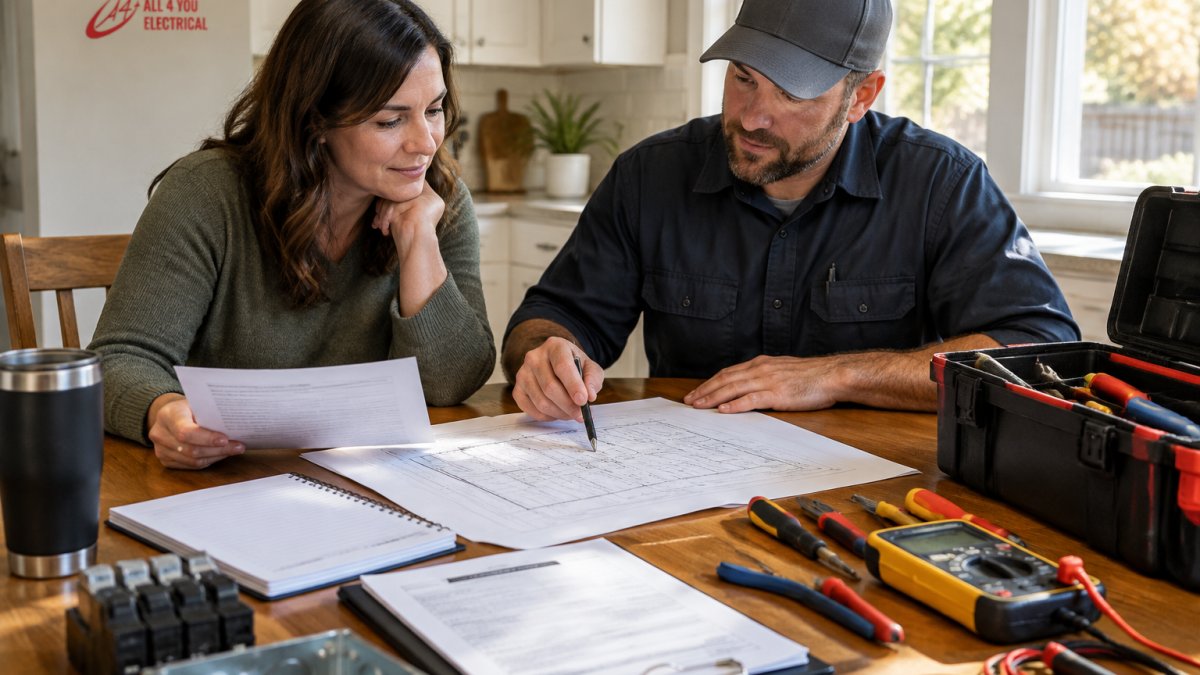
The man is American.
Watch out: skipping the load calculation is the most common reason a service upgrade permit gets rejected or flagged at rough-in. Do the math before you submit.
What to Do If Your Permit Application Is Denied
Denials are common and almost always fixable. The rejection notice usually states a reason code, and the fix depends on which one you got.
- Incomplete submittal. The notice cites a missing document. Resubmit with the load calculation, one-line diagram, or equipment spec sheet attached, the easiest denial to clear.
- Scope too vague. Rewrite the scope with specific amperage, equipment locations, and circuit counts, then resubmit.
- Contractor license issue. If the license is expired, suspended, or does not match the work classification, the permit will not issue. Verify status through your state licensing board before resubmitting.
If the denial reason is unclear, call the permitting office and ask for the specific code section or submittal requirement cited. Resubmittals typically do not require a new fee, but some jurisdictions charge a re-review fee after the second rejection, ask before resubmitting a third time.
Electrical Panel Upgrade Cost and Permit Fees
Permit fees for a residential panel upgrade are usually a small fraction of total project cost and vary widely by jurisdiction, some charge a flat fee based on service amperage, others a valuation-based schedule tied to declared project cost.
What drives the total cost of an electrical panel upgrade:
- Panel and breaker cost. A 200-amp panel with a full breaker complement costs more than a like-for-like replacement.
- Service entrance and meter base work. If the utility requires a meter base upgrade, that adds labor and coordination.
- Labor and access. A panel in a finished basement takes longer than one in an open garage.
For a detailed breakdown of what a panel upgrade involves and what moves the number, see our guide to the cost of an electrical panel upgrade.
The Inspection Process and Electrical Inspection Checklist for Homeowners
The inspection process has two stages, each checking different things. Knowing what inspectors look for helps you prepare and avoids a failed inspection that delays the project.
Rough-in inspection happens before drywall goes up. The inspector checks box fill, wire routing, staple spacing, grounding and bonding of the service, and that the panel is mounted correctly. Final inspection happens after energizing.
Here is the checklist we hand homeowners before inspection day:
- Permit posted and visible on site
- Panel directory labeled with every circuit
- All junctions accessible, not buried in walls
To prepare your home, read our guide to preparing your home for electrical upgrades.
What Happens If the Inspection Fails
A failed inspection stops the job until the correction is made and reinspected. The inspector leaves a correction notice listing each item, usually with a code reference. The most common failures on residential panel and service work:
- Grounding and bonding. The grounding electrode conductor is undersized, not bonded to the water pipe where required, or terminated loosely. This is the most common rough-in failure.
- Working clearance. Storage, shelving, or a water heater inside the dedicated space in front of the panel. The code requires clear space, and inspectors measure it.
- Panel directory. Missing, blank, or labeled vaguely like “lights” instead of specific room and circuit names.
When you get a correction notice: fix the item, photograph the correction, call for reinspection, and reference the original permit number. Some jurisdictions charge a reinspection fee after a failed attempt, ask your building department for its schedule before you book.
Watch out: do not cover drywall or energize the service to “save time” after a failed rough-in. Inspectors can require the wall to be opened again, and some jurisdictions treat energizing before rough-in approval as a separate violation.
Post-Inspection Documentation: What to Keep and Why
When the final inspection passes, the inspector signs the permit card or issues a certificate of completion, depending on the jurisdiction.
Keep these documents together in a home file, not in a drawer in the garage:
- The approved permit application with the scope of work
- The signed inspection card or certificate of completion
- The final inspection report, if the jurisdiction issues one
Why it matters at resale: most buyer disclosure forms ask whether permitted work was performed and inspected. A signed final inspection card lets you answer yes with documentation.
For insurance, the same documents matter. If a fire or electrical fault traces back to the panel, the insurer will ask whether the work was permitted and inspected, and the signed card answers that before it becomes a claim dispute.
Risks of Skipping Permits: Insurance, Resale, and Safety
Skipping the permit is the most expensive shortcut in home electrical work.
Insurance liability. Most policies exclude damage from work that was not permitted and inspected.
Resale value. A home inspection will flag an unpermitted panel.
Safety hazards. Undersized conductors, missing grounding, and double-tapped breakers are common in unpermitted work, the exact conditions that cause fires and electrocution.
Certificate of occupancy. If you added a living space or accessory unit, an unpermitted electrical system can block the certificate of occupancy entirely.
The U.S. Consumer Product Safety Commission tracks home electrical fires as a leading cause of residential fire deaths, and code enforcement exists to prevent exactly that. If you suspect your panel needs work, our guide to the 7 signs your electrical panel needs an upgrade helps you judge whether to call an electrician before you call the building department.
Get a Free Estimate on Your Permitted Electrical Upgrade
The permit process is manageable when you know the sequence, and it is genuinely risky to skip.
At All 4 You Electrical, we are a family-owned team with over 10 years of experience serving residential and commercial clients. We offer free estimates upfront, and we leave your property clean after service.
Idaho Division of Occupational and Professional Licenses maintains the state’s electrical contractor licensing records if you want to verify any contractor before hiring.
Get started with All 4 You Electrical and schedule a free estimate on your permitted electrical upgrade. You can also explore our electrical panel upgrade service to see how we scope panel work, or read about how our free estimates work before you call.
Frequently Asked Questions
Can I pull my own electrical permit as a homeowner?
In many jurisdictions, homeowners can pull an electrical permit for work on their primary residence, but rules vary by local building department. Some require the homeowner to pass a basic exam or sign an affidavit that they will do the work themselves. If you hire a licensed electrician, that contractor usually pulls the permit under their license. Always confirm with your local building department before starting, because doing work under someone else’s permit is a violation.
What are the risks of upgrading my panel without a permit?
Unpermitted electrical upgrade permits work creates real exposure. Your insurer may deny a claim tied to the unpermitted work, and a home sale can stall when a buyer’s inspector finds work with no record of inspection. Local code enforcement can require you to open walls for inspection or remove the work entirely. You also lose the safety check that catches grounding, bonding, and load calculation errors before they become hazards.
How much does an electrical panel upgrade cost, including permit fees?
Electrical panel upgrade cost depends on your service capacity, amperage target, and how much wiring must be brought up to code. Permit fees are set by your local building department and vary widely by jurisdiction, so ask for the fee schedule when you apply. All 4 You Electrical provides free upfront estimates, so you can see labor and material costs before committing. Request a quote for a number specific to your home.
What does the electrical inspection checklist for homeowners include?
Most inspections cover the panel label and breaker schedule, proper grounding and bonding, torque on lugs, correct wire sizing for the service entrance, and clear working space around the panel. Inspectors also check that the meter base and utility connections meet code. Keep your permit card and approved plans on site. Ask your electrician for the rough-in and final inspection dates so you can be present and get documentation afterward.
Your panel is the one part of your electrical system that everything else depends on. Get the permit, get the inspection, and get it done once. Contact All 4 You Electrical for a free estimate and a clear scope of work before the first wire is pulled.
