
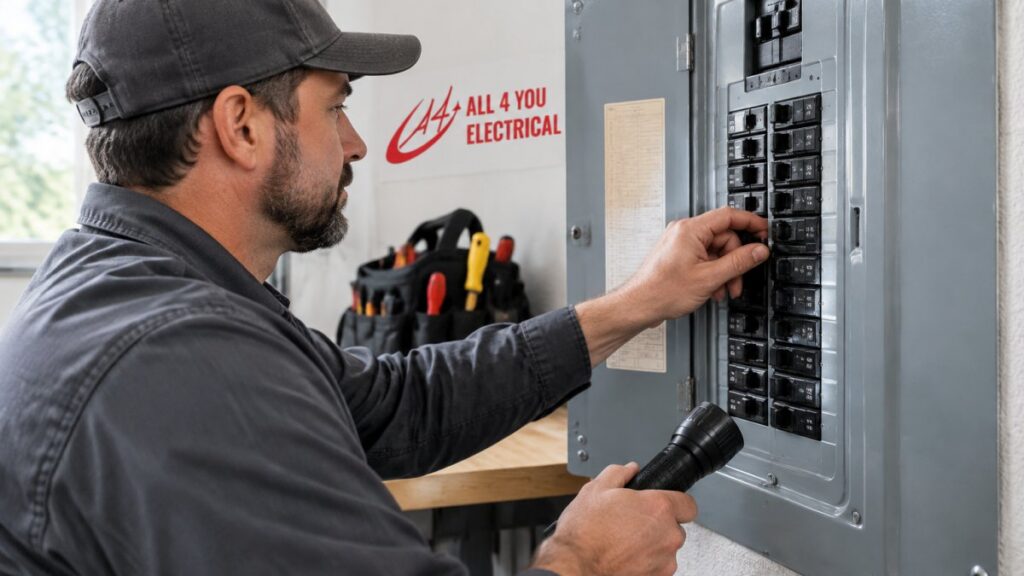
Last Updated: November 7, 2026
Quick Summary
A circuit breaker trips repeatedly when the underlying fault is never fixed: an overloaded circuit, a short circuit or ground fault, damaged wiring, or a faulty appliance. Each trip is a symptom, so stop resetting and diagnose the cause before the breaker will hold.
- A breaker that trips within one second points to a short circuit or ground fault.
- Trips after minutes of use suggest an overload or a loose, heating connection.
- Unplug everything on the circuit, reset once, then add devices back one at a time.
- Never open the panel cover yourself; live components can stay energized with breakers off.
- Stop resetting and call an electrician if the breaker will not hold after two attempts.
Table of Contents
- What a Circuit Breaker Does and Why It Trips
- Common Causes of Repeated Breaker Trips
- When the Breaker Trips Immediately After Reset
- Why a Breaker Keeps Tripping With Nothing Plugged In
- Why a Breaker Keeps Tripping in One Room
- Is a Repeatedly Tripping Breaker Dangerous?
- A Safe Step-by-Step Diagnostic Flow
- When to Stop Resetting and Call a Licensed Electrician
- Frequently Asked Questions
What a Circuit Breaker Does and Why It Trips
A circuit breaker is a safety switch that cuts power when current flow exceeds safe limits. It is the reason why a circuit breaker trips repeatedly matters more than most homeowners realize: each circuit breaker trips as a message about a problem you have not fixed yet.
Here is the short version. Your breaker senses too much current and shuts the circuit off before wires overheat. That is protection working as designed.
How the Trip Mechanism Protects Your Home
Inside every breaker sits a trip mechanism with two jobs. A bimetallic strip bends and opens the contacts during a slow overload. A magnetic coil snaps them open during a sudden surge from a short circuit.
Both paths exist to stop heat before it reaches your wiring insulation. Damaged insulation is where fire risk begins.
If you need the safe procedure for flipping a breaker back on, our guide on how to reset a tripped breaker safely walks through it step by step.
Common Causes of Repeated Breaker Trips
Repeated tripping almost always traces back to one of three families of problems: too much load, a fault in the wiring, or a failing appliance. The trick is telling them apart. Each cause leaves different clues.
Overloaded Circuits and Excessive Power Demand
An overloaded circuit is the most common cause. Too many devices draw more amps than the breaker rating allows. The total electrical load on that circuit simply exceeds its capacity.
Watch for these signs:
- The breaker trips when specific appliances run together
- Lights dim when a big appliance starts
- Warm outlets or warm cords near the panel
Space heaters, microwaves, and hair dryers are frequent culprits. So are older kitchens with too few circuits for modern power demand.
Short Circuits, Ground Faults, and Damaged Wiring
A short circuit happens when a hot wire touches a neutral or another hot wire. Current spikes instantly and the breaker trips fast. A ground fault is similar but sends current into the ground path instead.
Both point to damaged insulation, loose wire connections, or chewed wiring inside walls. These are not do-it-yourself fixes. Faulty wiring is a leading cause of home electrical fires, which is why these problems should be handled by a professional.
Faulty Appliances and Loose Connections
Sometimes the breaker is fine and the appliance is the problem. A damaged appliance with an internal short will trip the breaker every time it runs.
Loose connections cause a different pattern. A backstabbed outlet or a corroded neutral heats up under load, then trips after the circuit has been running a while. Vibration and corrosion both loosen connections over time.
When the Breaker Trips Immediately After Reset
A breaker that trips immediately after reset is telling you the fault is still live. The moment power flows, the trip mechanism senses the same problem and opens again.
This pattern narrows things down fast:
- Trip within one second: short circuit or ground fault
- Trip after several minutes: overload or a heating connection
- Trip only when one appliance runs: faulty appliance
If resetting no longer holds at all, the repair-or-replace question comes up. Our page on circuit breaker services explains when a breaker needs replacing versus when the panel itself is the issue.
Why a Breaker Keeps Tripping With Nothing Plugged In
A breaker that keeps tripping with nothing plugged in points to a fault inside the wiring itself. With no appliances drawing power, the only path left is a short, a ground fault, or a shared neutral problem.
Common explanations:
- A hardwired fixture or smoke detector on that circuit has failed
- Wiring inside the wall has been damaged by nails, pests, or heat
- Another circuit shares a neutral and back-feeds the trip
This is the pattern where guessing gets expensive. A professional inspection with a meter can locate the fault efficiently.
Why a Breaker Keeps Tripping in One Room
When a breaker keeps tripping in one room, the problem usually lives in that room’s circuit. Isolate it by unplugging everything on that circuit, then reset.
A common mistake is assuming the room’s outlets are all on one breaker. They often are not. Check the panel label, then test.
If the breaker trips with the room empty, the fault is in the wiring or a hardwired device.
Is a Repeatedly Tripping Breaker Dangerous?
Yes, a repeatedly tripping breaker can be dangerous, because the trip is the last line of defense against overheating wires. Electrical failures are a recognized cause of home fires (Electrical Home Fire Safety).
Stop and call for help if you see any of these:
- A burning smell near the panel or an outlet
- Scorch marks or discoloration on the breaker
- Buzzing or crackling sounds
- Warm outlets, warm cords, or a hot panel cover
Those signs mean the fault is active right now. If you are facing sparking outlets or a tripping breaker that will not hold, our emergency electrician service is built for exactly this situation.
A Safe Step-by-Step Diagnostic Flow
Start simple and work toward the panel.
Total time: 30-45 minutes
Difficulty: Beginner, with a hard stop at the panel
- Unplug everything on the affected circuit. [Time: 5 minutes] Label what you removed so you can reconnect it later. Include hardwired-adjacent items like a window air conditioner on a dedicated circuit if it has a plug.
- Reset the breaker once. If it holds, move to step 3. If it trips instantly, stop here and go to step 6.
- Add devices back one at a time. [Time: 15 minutes] Run each device for several minutes before adding the next. Note which device triggers the trip and whether the trip is immediate or delayed.
- Test that device on a different circuit. If it trips there too, the appliance is faulty. If it holds on another circuit, the problem is in the original circuit.
- Check for warm outlets, warm cords, or a burning smell. Any of these means stop now and leave the circuit off.
- Call a licensed electrician if the trip repeats with nothing plugged in. [Time: 2 minutes] A trip with no load points to wiring, a shared neutral, or a failing breaker, none of which are homeowner fixes.
Expected result: You either identify one faulty appliance or confirm the fault is in the wiring, which is the point where a professional takes over.
Watch out: never open the panel cover to inspect wiring or tighten terminals yourself. The panel contains live components that can remain energized even when breakers are off.
How Trip Timing and Conditions Narrow Down the Cause
Trip timing is the most underused clue in breaker troubleshooting. Fast trips mean faults. Slow trips mean heat. Conditional trips mean load.
Use this table to match the pattern to the likely cause:
| Trip Pattern | Likely Cause | Next Step |
|---|---|---|
| Trips instantly on reset | Short circuit or ground fault | Stop resetting, call an electrician |
| Trips after minutes of use | Overload or loose connection | Reduce load, check connections |
| Trips when one appliance runs | Faulty appliance | Test appliance on another circuit |
| Trips with nothing plugged in | Damaged wiring | Professional inspection |
| Trips in damp weather | Moisture in an outdoor circuit | Inspect outdoor outlets and fixtures |
| Trips after an appliance warms up | Internal appliance fault or thermal overload | Replace or repair the appliance |
When to Stop Resetting and Call a Licensed Electrician
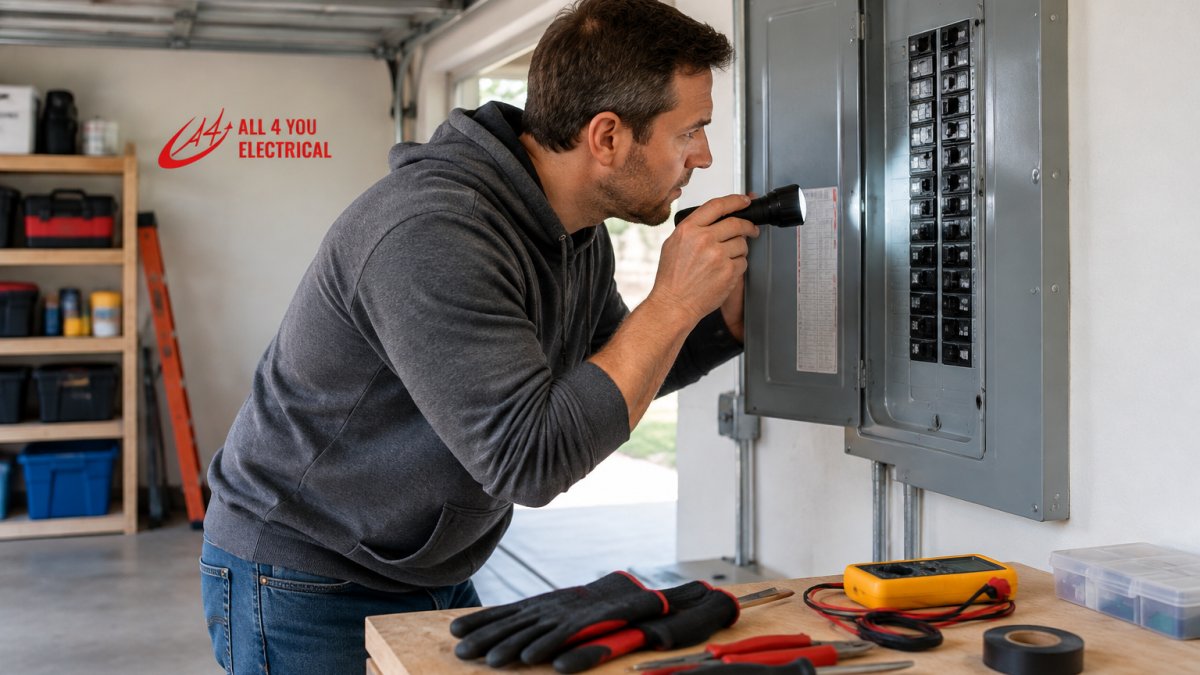
Stop resetting when the breaker will not hold after two attempts, when you smell burning, or when the panel feels warm. Those are stop-use criteria, not inconveniences. Repeated trips can also signal a panel that has reached its limit, or a breaker that is worn, mismatched, or the wrong type for the circuit.
Breaker-Specific Faults and Compatibility
Not every repeated trip is a wiring problem. The breaker itself can be the cause. A worn breaker may trip below its rated current, a condition sometimes called nuisance tripping.
A common pattern is a homeowner replacing a 15-amp breaker with a 20-amp breaker to stop trips on a circuit wired with 14-gauge wire. That defeats the protection and can overheat the wire inside the wall.
Modern Breaker Types and Their Indicators
AFCI and GFCI breakers trip for reasons a standard thermal-magnetic breaker does not detect.
If an AFCI or GFCI breaker trips repeatedly, the trip is a specific diagnostic signal, not a generic overload. A GFCI that trips in damp weather points to moisture in an outdoor circuit. An AFCI that trips when a specific appliance runs points to that appliance’s cord or internal wiring.
Urgent Hazards and Stop-Use Criteria
Leave the circuit off and seek urgent professional help if you see or smell any of the following:
- Smoke or a burning odor near the panel or an outlet
- Scorch marks, discoloration, or melted plastic on the breaker or outlet
- Buzzing, crackling, or sizzling sounds
- Visible arcing or sparks
Those signs mean the fault is active right now. Do not reset the breaker again, and do not use the circuit until an electrician has inspected it.
Signs Your Panel May Need an Upgrade
- The panel is warm to the touch
- Breakers trip more often than they used to
- You see rust, corrosion, or scorch marks
- The panel is old and full, with no room for new circuits
Our article on signs your electrical panel needs an upgrade covers the full checklist. When you are ready to have it looked at, our licensed residential electricians diagnose the cause and give you a free estimate upfront.
A breaker that trips once is doing its job. A breaker that trips again and again is asking you to act. All 4 You Electrical is family-owned, has served the area for over 10 years, and offers free estimates upfront with a clean workspace when the job is done.
Frequently Asked Questions
Why does my circuit breaker keep tripping repeatedly?
Repeated tripping usually points to an overloaded circuit, a short circuit, a ground fault, or a faulty appliance drawing too many amps. Loose wire connections and damaged insulation inside the panel or walls can also cause it. If the breaker trips again right after you reset it, the fault is likely still active on that circuit, so stop resetting and have a licensed electrician inspect the wiring and breaker rating.
Is it dangerous if a circuit breaker keeps tripping?
Yes, a repeatedly tripping breaker is a warning sign, not a nuisance. It can indicate damaged wiring, a ground fault, or a breaker that no longer trips at its rated amps, all of which raise fire risk. Warm outlets, burning smells, buzzing, or scorch marks mean stop using the circuit and call a licensed electrician. Ignoring repeated trips or taping the breaker switch in the on position removes your main protection against overcurrent.
Why does my breaker trip when nothing is plugged in?
A breaker that keeps tripping with nothing plugged in usually has a fault in the wiring itself, such as a loose wire connection, damaged insulation, or moisture reaching the circuit. It can also be a failing breaker or a shared neutral issue between circuits. Because the problem sits behind the walls or inside the panel, this is not a DIY fix. Shut the breaker off and schedule a professional inspection.
Should I keep resetting a breaker that trips?
Reset it once to see if the trip was a one-time overload, like a space heater and microwave running together. If it trips again, stop. Repeated resetting does not fix the underlying electrical fault and can stress the breaker or mask a hazard. Unplug appliances on that circuit, note what was running when it tripped, and call a licensed electrician to identify the cause before using the circuit again.
