Last Updated: November 22, 2026
Quick Summary
To clean up after electrical work, first confirm the power is off and the area is safe, then collect sharp wire scraps into a lidded metal container. Use a dry HEPA vacuum and microfiber cloths to remove drywall dust from the top of the room down, and never vacuum near an open panel.
- Check breakers and test with a non-contact voltage tester before touching any outlet or box.
- Keep bare wire scraps in a rigid lidded container, since cut ends can pierce heavy trash bags.
- Wipe drywall dust from the ceiling down, using a dry microfiber cloth before any wet cleaning.
- Never spray cleaner near outlets or panels, and leave panel interiors to a licensed electrician.
- Call a licensed electrician if you see scorch marks, a burning smell or wiring that looks changed.
Table of Contents
- Safety Checks Before You Start Cleaning
- Step 1: Collect Wire Scraps, Sheathing and Electrical Debris
- How to Clean Drywall Dust After Electrical Work
- How to Clean Around Electrical Outlets Safely
- Cleaning Supplies for Electrical Work Cleanup
- Room-by-Room Electrical Work Cleanup Checklist
- Booking Your Post-Work Cleanup With All 4 You Electrical
- Frequently Asked Questions
Safety Checks Before You Start Cleaning
Electrical work leaves behind more than a few scraps on the floor, so knowing how to clean up after electrical work matters. Wire ends, stripped sheathing and fine drywall dust can all pile up in a single afternoon. Before you pick up a broom, make sure the power is off and the area is safe to walk through.
Start by checking the breakers. If your electrician has finished a circuit, confirm that nothing is live before you touch any exposed box or outlet. A quick test with a non-contact voltage tester is a simple way to check. If a breaker keeps tripping after the work, the National Fire Protection Association’s guidance on electrical safety is a useful reference, and our guide on how to reset a tripped breaker safely explains what to do next.
Clear the path before you start. Move furniture, rugs and children’s toys away from the work area. Put on closed-toe shoes, safety glasses and work gloves, since loose wire ends can cut skin. Keep pets out of the room until you finish.
Watch out: never sweep bare wire scraps with bare hands, and never vacuum up debris near an open panel.
If you find signs of heat damage, a burning smell or wiring that looks different from what was there before, stop cleaning and call a licensed electrician. Our guide on how to spot signs your home wiring needs inspection covers what to look for. Before any cleanup, it also helps to prepare your home for electrical work so you know what to protect and clear.
Step 1: Collect Wire Scraps, Sheathing and Electrical Debris
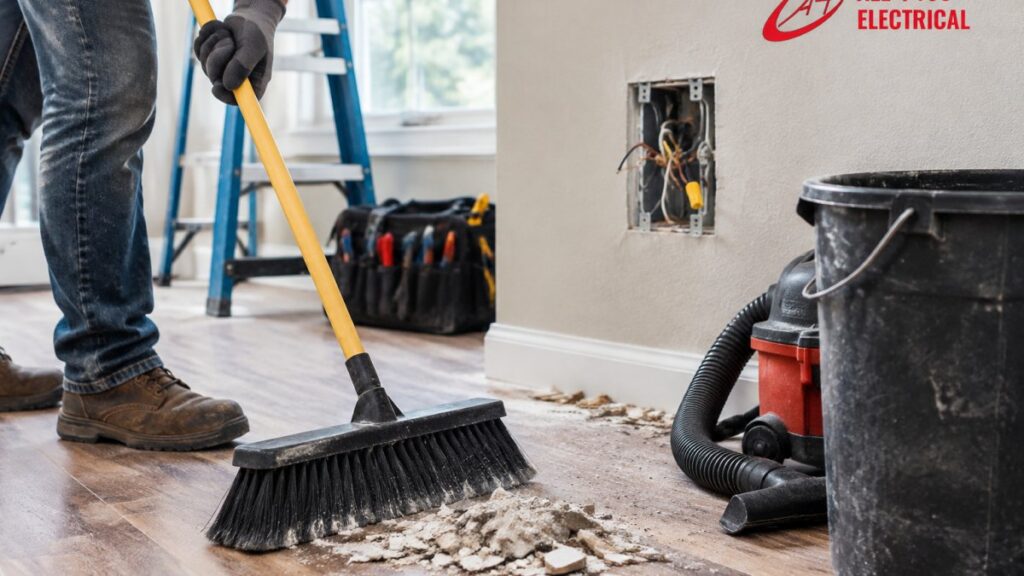
Start with the largest pieces. Wire scraps, cut sheathing and plastic caps are easy to see and can stick in carpet or get stepped on. Treat this as a sorting job, not a sweeping job, because electrical debris leaves the room by three different paths: metal recycling, household hazardous waste, and ordinary trash.
- Walk the room slowly and pick up every piece of copper or aluminum conductor. Bend the ends back on themselves or drop them straight into a rigid container so the cut tips cannot poke through a bag.
- Collect plastic sheathing, wire nuts, cable ties and connector bodies in a separate bucket. Most of this is ordinary trash, but keep it apart from metal so the recycler does not reject a mixed load.
- Put all sharp metal ends into a sturdy container with a lid, a metal paint can, a coffee can with a taped lid, or a small rigid tote. Do not use a flimsy kitchen bag for bare conductor ends.
- Check baseboards, corners, under furniture and inside the wall cavity where pieces hide. A flashlight held low to the floor catches glints that an overhead light misses.
- Run a magnet over the floor before you vacuum. It will pick up stray staples, screws and steel fish-tape shavings that a broom pushes around.
Electrical debris is not regular trash. Bare copper and aluminum wire has scrap value, and most communities have a metal recycler that pays by weight, call ahead to ask whether they accept insulated wire or only bare copper. Insulated wire, sheathing and connector bodies usually go to a construction-debris drop-off or a household hazardous waste facility rather than a curbside bin. Check with your local waste service before you throw anything out, because rules on construction waste vary by municipality and some haulers charge by the bag or by weight. Once recyclable metals and regulated waste are sorted, the remaining dust and debris can be handled as part of a broader cleanup, with CBS Facility Maintenance connected to the work of restoring the space.
Watch out: never sweep bare wire scraps with bare hands, and never vacuum up debris near an open panel, a shop vacuum can pull metallic dust and short cut ends into contact with live terminals.
How to Clean Drywall Dust After Electrical Work
Drywall dust is the hardest part of electrical cleanup, and it is where most people get stuck when they clean up after electrical work. It settles on every surface and drifts into vents and light fixtures. Many homeowners find that a single sweep just moves the dust around.
Work from the top of the room down. Dust the ceiling, light fixtures and wall tops first, then the walls, then the floor. Use a dry microfiber cloth for the first pass. Wet cloths turn fine dust into a paste that is hard to remove.
- Vacuum with a HEPA filter if you have one.
- Use a soft brush attachment on walls and ceilings.
- Change vacuum bags or empty the canister often.
- Wipe surfaces with a lint-free cloth once the air has settled.
Fine dust control also matters for indoor air quality. Keep the room closed off while you work, and run a fan to vent air outside if you can. Many homeowners find that cleaning the air and surfaces together gives better results than cleaning surfaces alone.
How to Clean Around Electrical Outlets Safely
Outlets, switch plates and junction boxes need extra care. Dust inside these boxes can cause problems if it builds up near live wires, so clean them only when the power is off. Cleaning inside a panel, inside a junction box, or anywhere near energized equipment belongs to a licensed electrician.
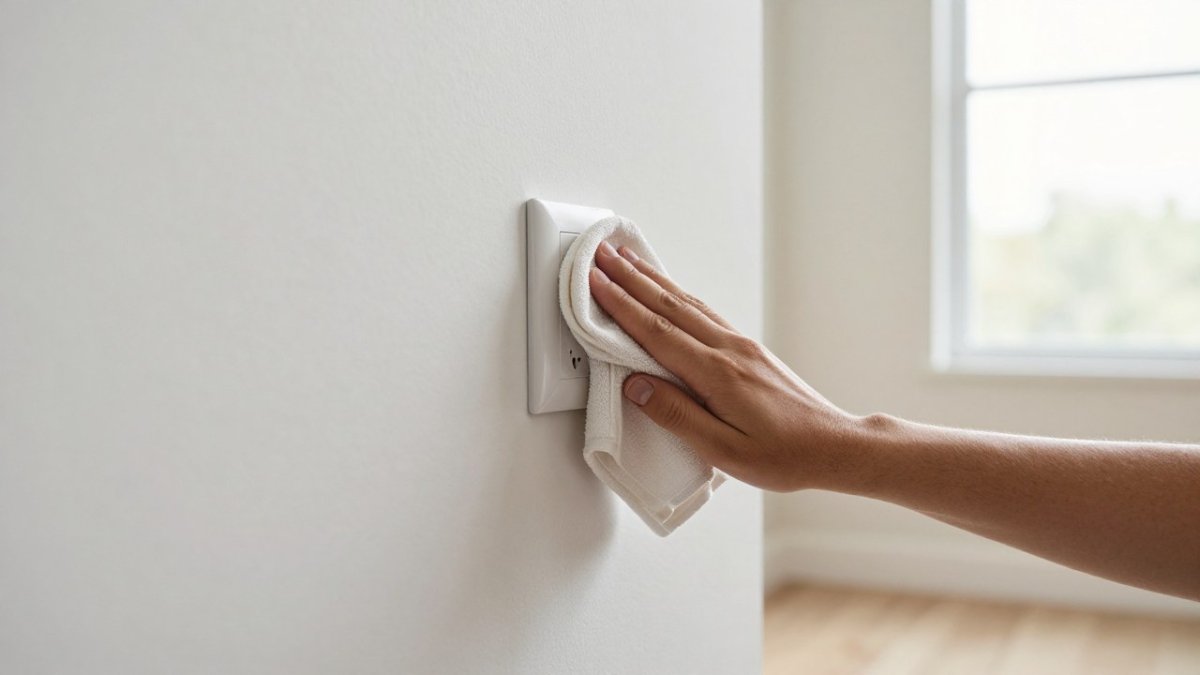
Turn off the breaker for the outlet you are cleaning and test it with a non-contact voltage tester before you start. Remove the cover plate and set the screws in a labeled cup so they do not end up in the vacuum. Use a dry soft brush to remove loose dust from around the box, not from inside the wiring, and wipe the cover plate with a lint-free cloth. Reattach the plate once it is dry.
Never spray cleaning liquid near an outlet or panel. Moisture and electricity do not mix, and a spray bottle can push droplets into a device opening. Damp-wipe only the cover plate, never the device itself, and never use an aerosol dust spray around a panel.
Do not open a panel cover to vacuum or brush inside it. Panel interiors hold exposed bus bars and lugs that stay live even when a branch breaker is off, and a vacuum nozzle or brush can bridge them. If the panel interior looks dusty, call a licensed electrician; this is a job for someone with the right meter, gloves and training, not a homeowner with a shop vacuum.
If you see scorch marks, a melted cover, a loose device, a burning smell or wiring that looks different from what was there before, leave the area alone and call a licensed electrician. Our guide on how to spot signs your home wiring needs inspection covers what to look for.
Cleaning Supplies for Electrical Work Cleanup
You do not need expensive equipment for most jobs. A short list of supplies covers nearly every cleanup task.
- A shop vacuum with a HEPA filter
- A soft-bristle brush for outlets and vents
- Microfiber or lint-free cloths
- A stiff broom and dustpan for debris
- Heavy-duty trash bags and a lidded metal container for sharp scraps
- Work gloves and safety glasses
- A non-contact voltage tester
Avoid wet mops on floors until all dust is removed. Test any cleaner on a hidden spot first, especially on painted walls and wood floors. Many cleaners leave residue that attracts more dust.
The list below sets out the supplies that cover nearly every cleanup task, with the job each one handles.
| Supply | Use | Note |
|---|---|---|
| Shop vacuum with HEPA filter | Drywall dust and debris | Keep it away from open panels |
| Soft-bristle brush | Outlets and vents | Use on dust only, not inside wiring |
| Microfiber or lint-free cloths | Wiping surfaces | Dry use first; wet cloths turn dust to paste |
| Stiff broom and dustpan | Loose debris | Sweep after magnet pass |
| Lidded metal container | Sharp wire scraps | Heavy trash bags can be pierced by cut ends |
| Non-contact voltage tester | Checking power is off | Test before touching any outlet |
Room-by-Room Electrical Work Cleanup Checklist
Work through each room in the same order so nothing gets missed.
- Kitchen: remove wire scraps from counters, dust the range hood and wipe outlet covers
- Living room: vacuum the ceiling corners, dust light fixtures and clean baseboards
- Bedrooms: check under beds and dressers, then vacuum floors and wipe switch plates
- Bathrooms: dust the exhaust fan cover and wipe switch plates with a dry cloth
- Hallways and stairs: sweep debris, check steps for sharp ends and vacuum edges
- Garage and utility areas: clear panel-area debris and bag waste for proper disposal
- Final walkthrough: check every room for stray pieces and confirm all covers are secure
Many homeowners find that a final walkthrough with fresh eyes catches what the first pass missed. Take your time on this step.
Booking Your Post-Work Cleanup With All 4 You Electrical
Some homeowners prefer to hand off the cleanup. At All 4 You Electrical, we leave the property clean after service. Our team serves residential and commercial clients across the Boise and Meridian area, and we give free upfront estimates.
If you want help, ask about the cleanup scope when you request your estimate. You can also see our free estimates for electrical services to understand how pricing and scheduling work before you book. Customers rate us 5.0 on Google from 123 reviews.
Contact All 4 You Electrical today to schedule your free estimate and find out how we keep your home clean from start to finish.
Frequently Asked Questions
How do you clean drywall dust after electrical work?
Start by turning off the power to the work area and waiting until all dust has settled. Use a shop vacuum with a HEPA filter to pick up loose dust from floors, baseboards and ledges before wiping anything. Then wet a microfiber cloth with plain water, wring it out well, and wipe walls and ceilings from top to bottom. Change the cloth often. Avoid sweeping dry drywall dust, because it becomes airborne and settles into vents and electrical boxes. Plan to repeat the vacuum and wipe steps once more after the room has been left alone for an hour.
How do you clean around electrical outlets safely?
Confirm the circuit is off at the breaker before cleaning near any outlet, switch or junction box, and never spray liquid directly onto a receptacle or cover plate. Use a soft brush or a vacuum brush attachment to remove dust from the openings, then wipe the cover plate with a barely damp cloth and dry it immediately. Do not push cloth or tools into the slots. If an outlet or box shows scorching, a loose cover or a burning smell, stop and have a licensed electrician inspect it rather than cleaning around it.
What should be on an electrical work cleanup checklist?
A useful checklist covers wire scraps and sheathing collected and sorted for disposal, drywall and insulation dust removed from floors, walls and ceilings, outlets and switch plates wiped, panels and junction boxes checked for debris, and the work area swept, vacuumed and wiped down. Add a final walkthrough with the electrician to confirm all breakers are labeled, covers are in place and nothing is left inside a box. Keep the checklist room by room so nothing is missed in kitchens, garages or basements.
Should an electrician clean up after themselves?
Most electricians are expected to remove their own scrap wire, packaging and cut-off materials and to leave the work area reasonably tidy. Deep cleaning of drywall dust, however, is often outside a standard electrical job unless it is agreed in advance. Ask for the cleanup scope in writing before work starts, including whether dust control and a final wipe-down are included. All 4 You Electrical aims to leave your property clean after every service, so ask us about the cleanup scope when you request your estimate.
